Remote Software Engineers Salaries Across Europe in 2026
If you're a remote developer working from a flat in Lisbon, a co-working space in Warsaw, or your kitchen table in Berlin — you've probably wondered how your paycheck stacks up against the rest of Europe. Turns out, the answer depends a lot on where you are, who you work for, and what kind of engineer you happen to be.
We dug into the latest salary data from sources like RemotifyEurope, Ravio, Ruby on Remote, Index.dev, and Glassdoor to paint an honest picture of EU remote developer pay in 2026. Some of the numbers might surprise you. Others will probably just confirm what you already suspected. (And if you're actively looking, you can browse the latest remote jobs across Europe right here on RemotifyEurope.)
Let's get into it.
The Big Picture: What Does "Average" Even Mean Here?
According to data aggregated across 223 reported remote developer salaries in Europe (as of early 2026), the average lands around $119,988 per year. But here's the thing — that number is almost meaningless on its own. The range stretches from roughly $23,000 all the way up to $400,000. That's not a salary range; that's a canyon.
What's driving such wild variation? Country, seniority, specialisation, and whether you're working for a local startup or a US-based tech giant all play a role. Europe has the largest country-to-country salary differences of any region — bigger than Latin America, bigger than Canada. A senior dev in Zurich and a senior dev in Tirana might have similar skills, but their paychecks live in completely different universes.
So averages aside, let's look at what's actually happening country by country.
The Top Earners: Where the Money's Best
No surprises at the very top. Switzerland leads Europe by a wide margin, and it's not even close.
Country | Annual Salary Range (USD) | Notable |
|---|---|---|
🇨🇭 Switzerland | $97,500 – $127,700 | Zurich avg ~$110K; juniors start at ~$89K |
🇩🇰 Denmark | $63,700 – $87,000 | Strong work-life balance culture |
🇳🇴 Norway | $57,000 – $78,000 | High CoL offsets some gains |
🇬🇧 United Kingdom | ~$55,300 (London: ~$74,000) | London premium is real |
🇩🇪 Germany | $52,300 – $64,000 | Munich ~$67K, Berlin ~$65.5K |
🇸🇪 Sweden | ~$61,500 | Stable market, modest growth |
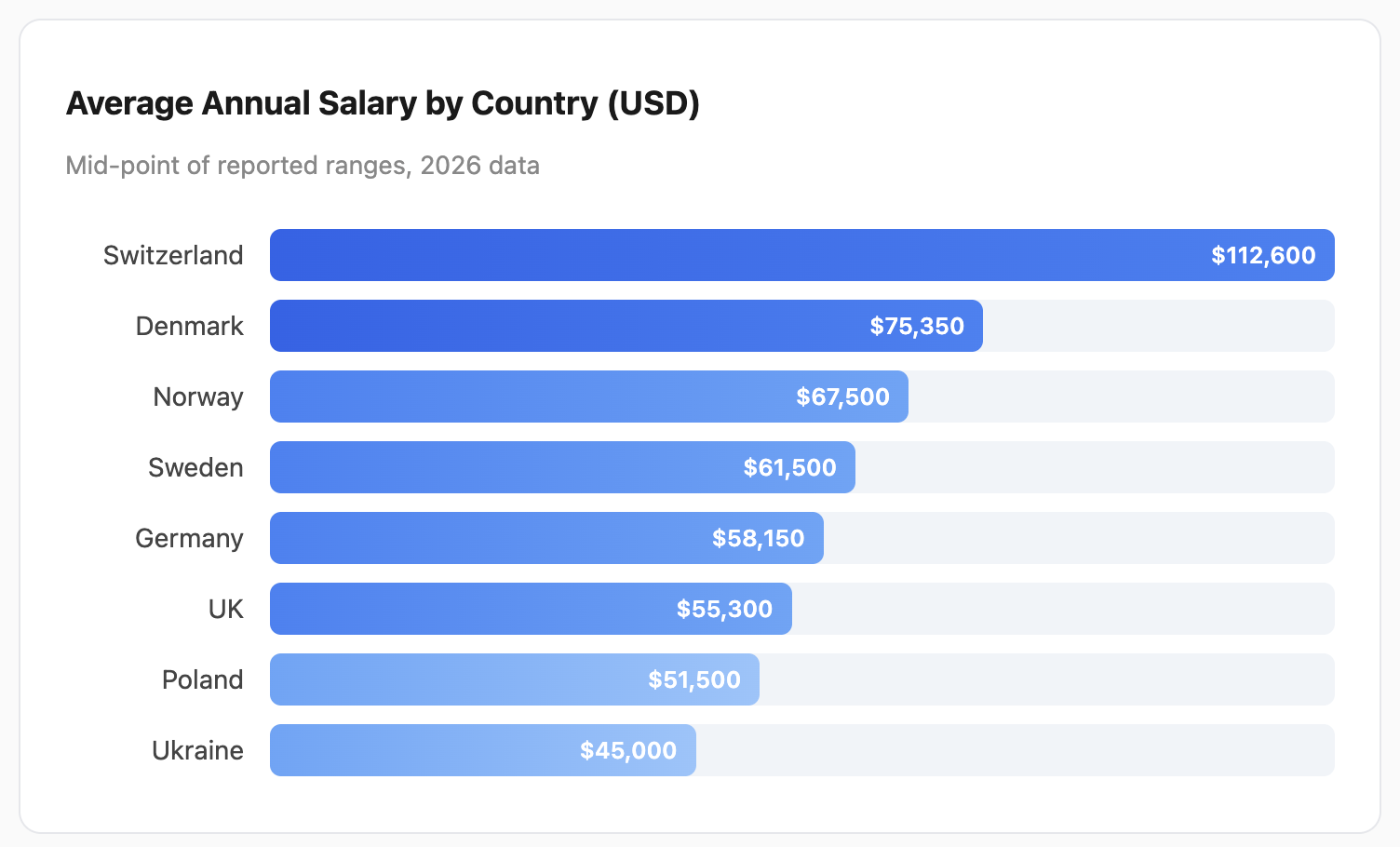
Swiss developers earn so much that even their junior engineers — at around $89,600 annually — out-earn mid-level developers in most other European countries. Mid-level Swiss salaries push past $127,000. Of course, if you've ever bought a sandwich in Zurich, you know that cost of living eats into those numbers pretty aggressively. Housing, transport, groceries — it all adds up fast.
Denmark and Norway round out the Nordic trio with strong salaries, though neither touches Switzerland. The UK is interesting: the national average sits around $55,000, but London-based engineers pull in about $74,000 — a roughly 34% premium just for being in the capital. Germany's a solid mid-tier earner in Western Europe, with Munich edging out Berlin by a small margin.
Worth noting:Germany's average senior software engineer salary hit roughly €111,800 (~£97,300) in 2025, marking a 4.5% year-over-year increase. The Netherlands isn't far behind at €110,100 for senior roles. These are solid jumps, even if the broader market is cooling off a bit.
The Middle of the Pack: Western and Southern Europe
France, Spain, Portugal, and the Netherlands occupy that middle ground — decent salaries, lower cost of living (compared to the Nordics), and increasingly attractive to remote workers who want a good quality of life without chasing the absolute highest paycheck.
Country | Avg. Salary (EUR) | Senior Salary (EUR) | YoY Growth |
|---|---|---|---|
🇫🇷 France | €65,600 | €96,200 | +5.4% (senior) |
🇪🇸 Spain | €55,900 | €83,400 | +4.0% (senior) |
🇵🇹 Portugal | €28,600 – €55,000 | — | Varies widely |
🇳🇱 Netherlands | $43,200 – $86,500 | €110,100 | +1.7% (senior) |
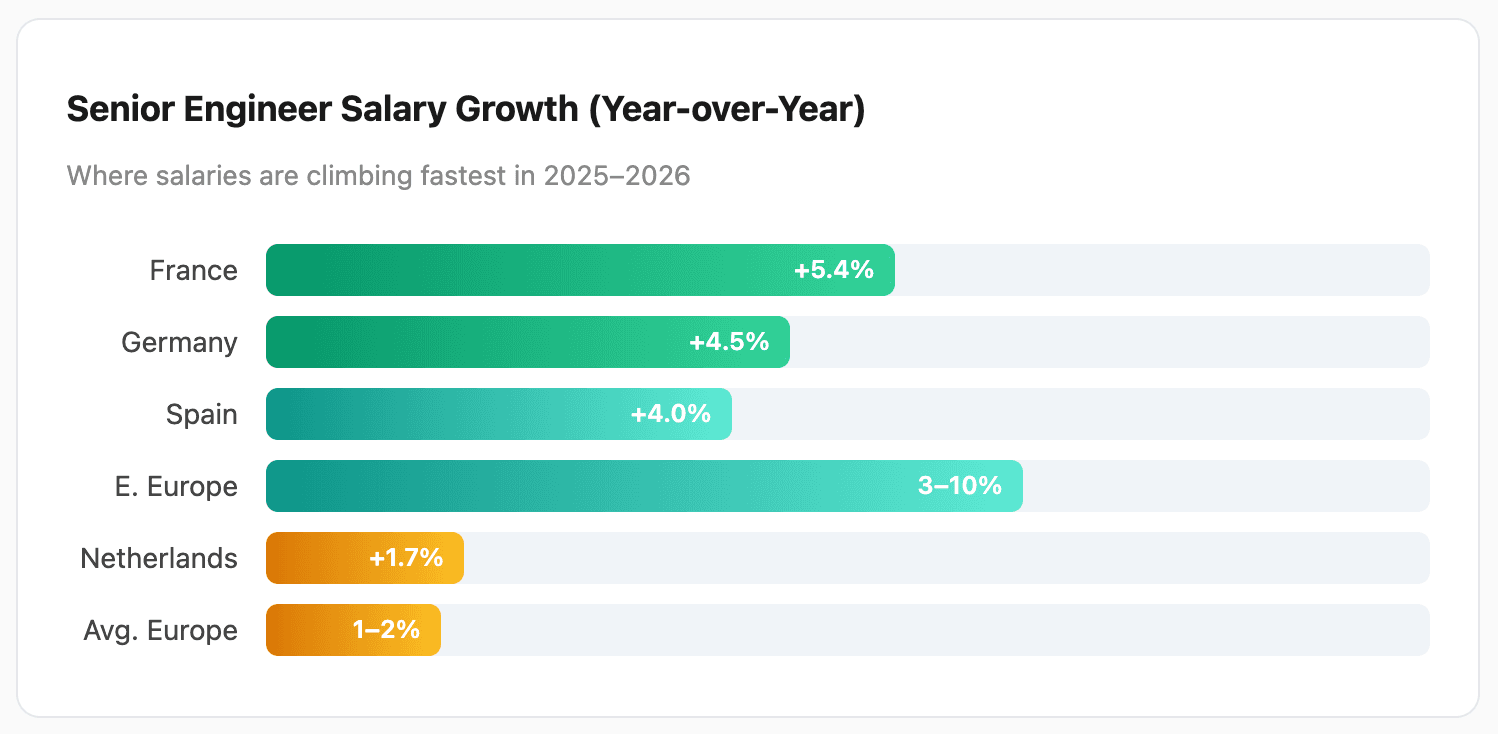
France has been quietly strong for senior devs — a 5.4% salary increase for senior software engineers is nothing to scoff at when most of Europe saw 1–2% bumps. Spain's growing tech scene in Barcelona and Madrid is pulling in more remote workers, and the cost of living still gives you room to breathe. Portugal is the wildcard here. Lisbon's become a digital nomad hotspot, but local salaries remain on the lower end (Glassdoor puts the Lisbon average around €40,250). The real play in Portugal is working remotely for a higher-paying company elsewhere.
The Netherlands deserves a special mention. Senior engineers there are pulling in around €110,000, and the country's flexible work culture — especially around hybrid arrangements — makes it one of the more progressive markets in Europe. Dutch companies were among the first to formally embrace remote-first policies, and that trend hasn't slowed down.
Eastern Europe: The Rising Tide
Here's where things get really interesting. Eastern European developer salaries have been climbing steadily, and the gap between East and West is narrower than it was even two years ago.
Country | Salary Range (USD) | Notes |
|---|---|---|
🇵🇱 Poland | ~$50,000 – $53,000+ | Strongest in the region |
🇺🇦 Ukraine | ~$45,000 (senior) | Resilient market despite challenges |
🇱🇹 Lithuania | $15,000 – $88,000 | Wide range reflects seniority gap |
🇷🇸 Serbia | $17,000 – $86,000 | Growing outsourcing hub |
🇸🇮 Slovenia | $26,000 – $70,000 | Small but competitive market |
🇭🇷 Croatia | $15,000 – $63,000 | Emerging tech scene |
🇲🇩 Moldova | $22,000 – $49,000 | — |
Western European salaries average $78,000 to $110,000 annually. Eastern Europe? More like $48,000 to $54,500. That's a meaningful difference, sure. But it's shrinking. Most Eastern European markets are seeing annual salary increases of 3–10%, and in specialties like AI, machine learning, and cybersecurity, the jumps can be even bigger.
Poland is the standout here. At around $50,000–$53,000+ for experienced developers, it's become Europe's go-to market for high-quality engineering talent at competitive rates. Lithuania and Serbia show some of the widest salary ranges — reflecting the enormous gap between junior and senior compensation in those markets.
Tax advantages worth knowing about: Some Eastern European countries offer genuinely favourable tax setups for tech workers. Bulgaria has a flat 10% employee income tax. Romania offers an effective rate of around 10% for IT workers thanks to specific exemptions. When you factor in these tax breaks, the take-home pay gap between East and West gets even narrower.
Working for US Companies From Europe
This is where a lot of the real money is for European-based remote developers. If you can land a role with a US company while living in Europe, you're often looking at $73,800 to $107,900 in median salary. That's 40–60% less than what US-based engineers earn for the same work — but it's significantly more than most local European salaries.
There's a catch, though. Employment costs for companies hiring in Europe vary wildly. In Poland, the added employer costs sit around 22%. In Spain, they can balloon to 36%. That means companies are factoring these costs into their offers, which can push individual salaries down. Still, for a developer in Warsaw or Lisbon, a US remote salary often feels like a small jackpot compared to local options.
Some companies are getting creative with their cost structures, too. A growing strategy involves pairing senior Western European architects (billing €80–100/hour) with implementation teams from Central and Eastern Europe (€32–45/hour). Companies using this model report saving 35–42% on development costs. Clever? Absolutely. But it also creates real opportunities for skilled CEE developers to work on high-profile projects they might not otherwise access.
The Remote Work Landscape: Hybrid Wins (For Now)
You can't talk about remote salaries without talking about remote work itself — and the landscape in Europe is shifting, though maybe not in the direction you'd expect.
About 83% of workers in remote-capable roles now prefer some form of hybrid work. Currently, around 52% of those workers are hybrid, 26% are fully remote, and the rest are back in the office full-time. In the tech sector specifically, the split looks a little different: 58% of roles are fully on-site, 29% hybrid, and 13% fully remote.
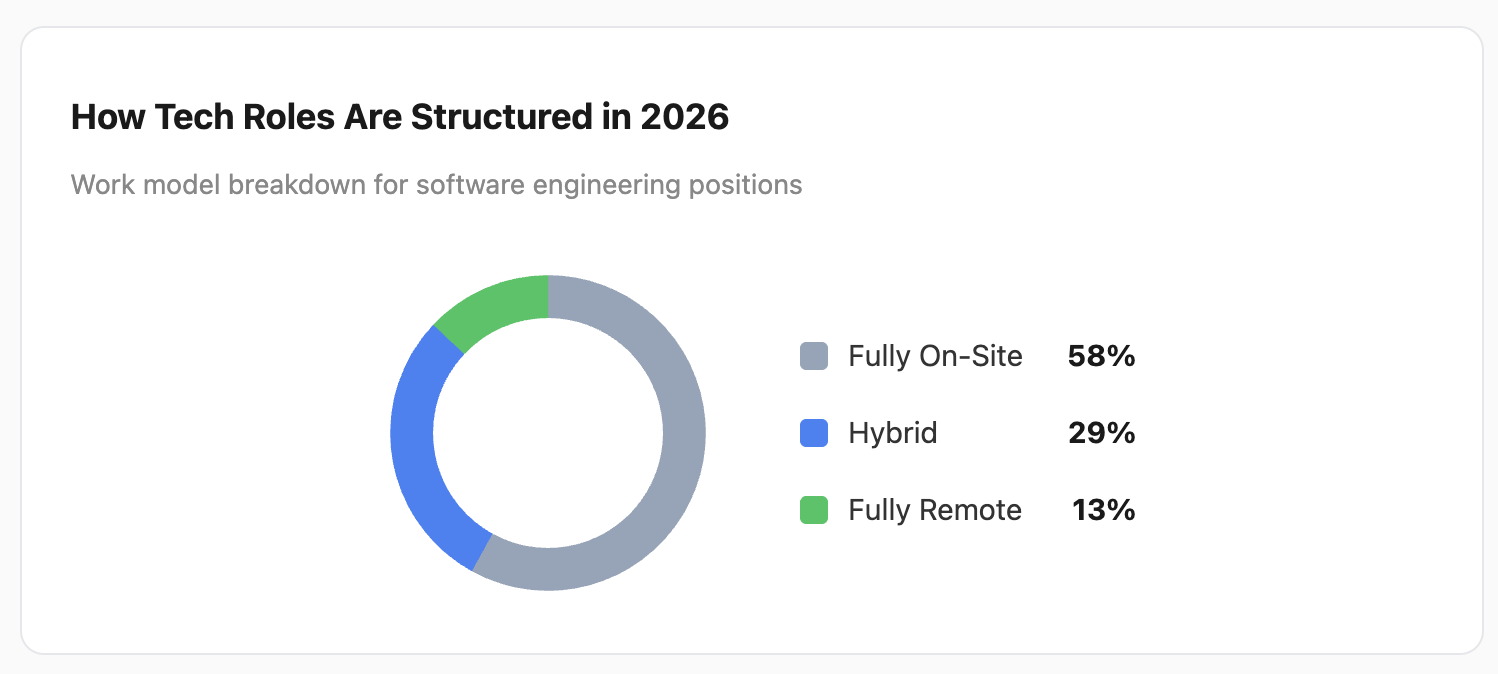
That last number — 13% fully remote — might feel low, especially if you're living in the remote-work-forever bubble. But here's some important context: software engineer remains the single most remote-hired job title on major platforms. And over 40% of European job seekers say they'd reject an offer outright if it didn't include remote options. So companies that refuse to budge on flexibility are fighting an uphill battle for talent. (If you're a company struggling to fill engineering roles, posting a job on RemotifyEurope is a good place to start.)
The return-to-office push is real, though. By 2026, roughly 30% of companies are expected to require five-day office attendance. Another 17% are aiming for four days. But it's the smaller companies — those with fewer than 250 employees — that are keeping the remote dream alive. In Germany, the UK, and the US, SMEs accounted for the most new remote hires, and European SMEs in particular have stayed committed to flexible arrangements.
Scandinavia and the Netherlands continue to lead Europe in flexible work adoption, with formal policies around digital collaboration and even "right to disconnect" regulations gaining ground.
The AI Premium: A New Salary Lever
One trend that's impossible to ignore in 2026: AI engineers are getting paid more. Quite a bit more, actually.
Ravio's compensation data shows an average 12% salary premium for AI engineers on the individual contributor track compared to general software engineers. On the management track, the premium is smaller — around 3% — but it's still there. If you've been thinking about upskilling in machine learning or AI tooling, the financial case has never been clearer.
This isn't just a Western European phenomenon, either. About 57% of EU firms report they can't find enough qualified tech staff, and that shortage spans from junior JavaScript developers to senior AI engineers. The talent crunch is real, and it's pushing salaries up — especially in high-demand specialties.
So What Does This All Mean For You?
If you're a remote software engineer based in Europe right now, here's the honest takeaway: where you live matters less than it used to, but it still matters. A lot.
The sweet spot — and this isn't exactly a secret — is living in a lower cost-of-living country while working for a company headquartered somewhere expensive. A senior dev in Lisbon working for a London-based company can do incredibly well. A mid-level engineer in Krakow picking up contracts for a San Francisco startup is probably out-earning their local peers by 2–3x.
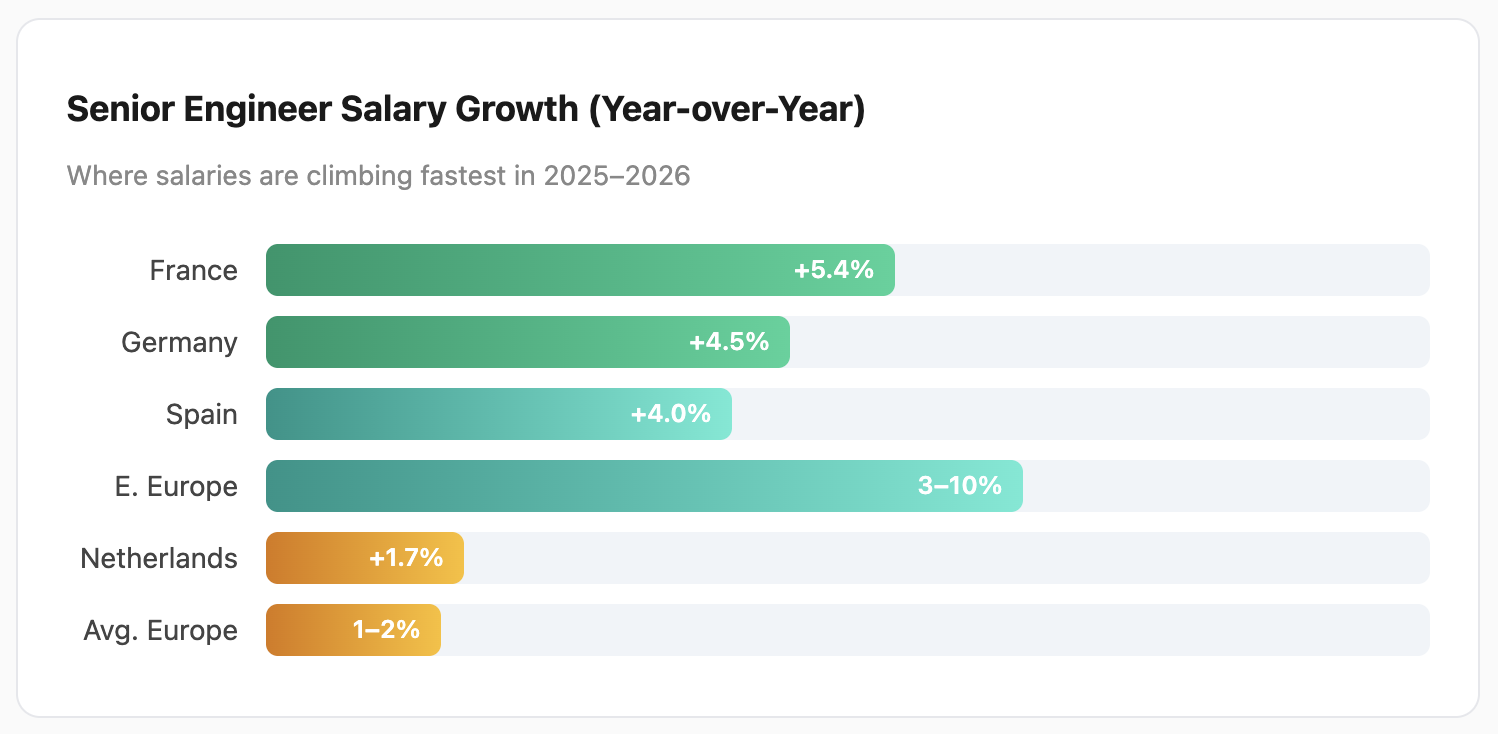
Salary growth across Europe has slowed to about 1–2% in most markets, which is a noticeable cooldown from the post-pandemic boom years. But there are bright spots. Senior roles in France (+5.4%), Spain (+4.0%), and Germany (+4.5%) are still seeing healthy bumps. And Eastern Europe's 3–10% annual growth means the region is slowly but steadily closing the gap.
If you're early in your career and want to maximise earnings, the data points clearly toward two paths: move into AI/ML specialisation (that 12% premium adds up fast over a career), or position yourself to work for companies in higher-paying markets while keeping your living costs manageable.
Either way, 2026 is a year where being a remote software engineer in Europe still feels like a pretty good deal. The salaries are climbing, the flexibility is mostly intact, and the continent's talent shortage means you've got more leverage than you might think. If you're ready to explore what's out there, browse remote engineering roles on RemotifyEurope — or get in touch if you've got questions about the European remote job market.
Just don't compare yourself to the Swiss junior developers. That way madness lies.