How to Build a Remote Hiring Pipeline That Fills Itself (The Recruiter's Blueprint)

Someone resigns on a Tuesday. By Wednesday there's a job description being dusted off, by Friday it's posted, and for the next six weeks the rest of the team quietly absorbs the extra work while everyone hopes the right person shows up.
I've lived this from the inside. At one of my previous companies you could set your watch by it: hiring only started once somebody handed in their notice, or once it was obvious a person was on their way out. Nobody was lined up. The people who stayed carried the load until a replacement arrived, and some of them started browsing job ads themselves in the meantime. Which, if you think about it, is how one vacancy turns into two.
A remote hiring pipeline is the fix for that. And no, "fills itself" isn't magic. It means that when a role opens, you're picking up conversations that already exist instead of starting from a blank page. This guide walks through how to build one, step by step, for teams hiring across European time zones.
Quick disclaimer before we get going: I'm not an HR or talent acquisition professional. I run a remote job board, I've been a remote employee for years, and I've been on the receiving end of a lot of recruiter outreach. So take this as the view from the marketplace and from the candidate's side of the table. I think that's a useful angle, but you know your own org better than I do.
What a remote hiring pipeline actually is
A job post is an event. A pipeline is a habit.
The simplest definition I can give you: a remote hiring pipeline is a standing pool of people you've already identified, attracted or spoken to for roles you know you'll hire again. It has a few moving parts (inbound applications, outbound sourcing, a talent pool you keep warm) but the idea underneath is always the same. You do the slow work before the pressure arrives.
Reactive hiring | Pipeline hiring | |
|---|---|---|
Starts when | Someone resigns | Before the role exists |
First step | Write a JD, post it, wait | Message people you already know |
Candidate pool | Whoever is job hunting this month | Active applicants plus warm passive talent |
Who pays for the delay | The teammates covering the gap | Nobody, ideally |
Knowledge after the hire | Thrown away | Kept, tagged, reused |
Why the clock is against you
Hiring takes longer than most managers assume when they say "let's just backfill it." SHRM's 2026 benchmarking puts the median time to fill a non-executive role at 39 days, an improvement on the 44 days it reported a year earlier. Executive roles sit around 45. And technical roles are in a different league: Gem's 2026 recruiting benchmarks put engineering and technical positions at 62 days on average.
How long a role stays open (days to fill)
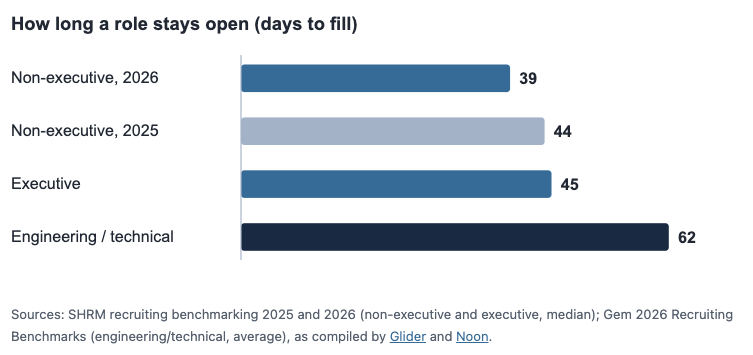
So you're looking at five to nine weeks of an empty seat, and that's the average, not the bad case. A pipeline doesn't make interviews faster. What it removes is the dead time at the front, the weeks spent waiting for the right people to notice you exist.
Step 1: Pick the roles worth building a pipeline for
Don't try to build a pipeline for everything. You'll burn out by week three.
Start with what I'd call your evergreen roles: the positions you hire for repeatedly, or the ones where a vacancy really hurts. From what I see on RemotifyEurope, tech roles and customer support roles dominate remote hiring in Europe, and they're also the ones companies come back for again and again. Support teams grow in steps. Engineering teams always seem to need one more person.
For each evergreen role, write down three things:
The time zone band. CET, EET, WET, or a defined overlap window like "at least four hours of overlap with Central European Time." Decide this now; it shapes where you source.
The salary range. An approved one, not a hope.
The countries you can actually hire in. More on that in Step 6.
Two or three roles is plenty to begin with.
Step 2: Write the job description once, and write it properly
Your job description is the most reused asset in the whole pipeline. It becomes the listing, the pitch in your outreach messages, and the thing a referred candidate gets forwarded at 10pm. So it deserves an afternoon of real attention.
If you ask me what separates listings that get plenty of Apply clicks from the ones that sit there, the answer is boringly consistent. It's the ones that show a salary and spell out the time zone. That's it. Clever titles and long culture paragraphs don't come close.
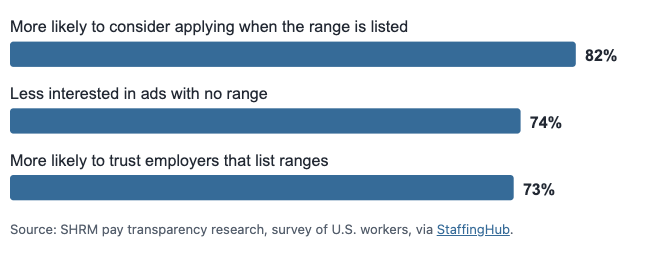
The research agrees with what I see on the board. In SHRM's pay transparency survey of U.S. workers, 82% said they're more likely to consider applying when the pay range is listed, 74% said they're less interested in ads without one, and 73% said they trust organizations that publish ranges more than those that don't.
What a salary range does to candidate behaviour
In Europe this is fast becoming a legal question rather than a stylistic one. The EU Pay Transparency Directive requires employers to share starting pay or a range with candidates in the job ad or before the interview. Only a handful of member states had it on the books by the June 2026 deadline, Italy among them, and the effect there was immediate: according to Indeed data reported by Euronews, the share of Italian job postings with salary information jumped from 26% in July 2025 to 61% a year later. The rest of the EU is at various stages, so check the rules for the countries you hire in. My opinion? Don't wait for the law. Publish the range now and collect the applications your competitors are leaving on the table.
If you want a starting point, we've put together a free remote job description template that covers salary, time zone, and the other details remote candidates look for first.
Step 3: Keep an always-on inbound channel
This is where "fills itself" starts to mean something.
Most companies post a job, pull it the moment they hire, and go dark until the next emergency. The employers who seem happiest with their results on RemotifyEurope do the opposite. They run campaigns over a longer stretch. One of our customers has bought a five-pack of listings every month for the past four months, for the same roles. They aren't in a hurry. They keep the roles visible, let applications build up, and wait for the right people to come to them.
That patience is the whole trick. A listing that's live for months catches the candidate who wasn't looking in September but is very much looking in November.
A few practical rules for always-on listings:
Say what it is. If the role is ongoing or you're building a talent pool, write that in the ad. Candidates forgive a slow process; they don't forgive being misled.
Reply to everyone. Even a two-line "not now, but we'd like to keep your details" keeps the door open.
Go where your candidates already are. A general board gives you volume. A niche board gives you people who've already filtered themselves, in our case candidates who specifically want remote work in European time zones.
If you want to test this, you can post a job on RemotifyEurope as a single listing or buy a pack and spread it across several months. The pricing page has both options.
Step 4: Passive candidate sourcing for remote roles
Inbound only reaches people who are looking. And most people aren't, at least not officially. LinkedIn's long-running talent research splits the global workforce into roughly 30% active job seekers and 70% passive talent.
Who your job ad reaches, and who it doesn't
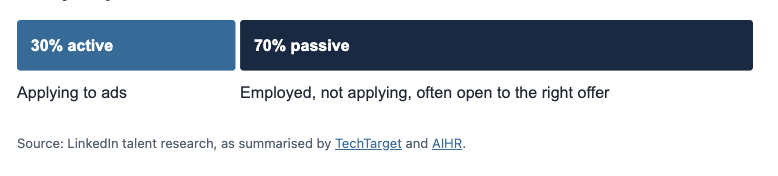
Here's the nuance I'd add from running a weekly newsletter for remote job seekers. "Passive" is a bit of a myth. A lot of our subscribers are perfectly happy where they are, and they still read every issue. They're always keeping an eye out for a better role. In this job market people feel their employment is never fully safe, so keeping options open is just sensible. Your passive candidates are watching. They just aren't applying.
That changes how you should approach them.
How not to do it
A recruiter once reached out to me on LinkedIn about a remote role. Good start. I replied, and the next message told me to go to the company website and apply there.
I still don't understand that one. You're a recruiter. You found me, you contacted me, and then you handed me the same form a stranger would fill in? If I'd wanted to apply cold, I'd have done it already. The outreach made things worse than no outreach at all.
How to do it
Lead with the two things they'll ask anyway: the salary range and the time zone expectations.
Show you looked. One specific line about their work beats three paragraphs about your company.
Offer a conversation, not a form. If you made the first move, you carry the next step. A 15-minute call, no CV required.
Make "not now" a good answer. Ask if you can check in again in a few months. Most will say yes.
A first message that respects people's time
Hi [Name], I came across your work on [specific project or post] and it's close to what our [team] is building.
We're hiring a [role], fully remote, working roughly [hours] CET. The range is [€X–€Y].
No need to apply anywhere. If it sounds interesting, I'd be glad to do a quick 15-minute call. And if the timing is wrong, would you mind if I checked back in a few months?Where to look depends on the role, but for European remote talent the usual places are LinkedIn, GitHub and portfolio sites for technical roles, niche communities and newsletters, past applicants, and referrals from your current team.
Step 5: Build the talent pool (this is the part everyone skips)
Every search you run produces people who were good but not hired. The runner-up. The strong candidate whose timing was off. The passive contact who said "maybe next year." In reactive hiring, all of that evaporates when the role closes. In a pipeline, it's your head start on the next one.
You don't need fancy software for this. A spreadsheet or your ATS will do, provided you tag each person with the role family, their time zone, their country, how far they got, and when you last spoke. Then give each group a rhythm:
Pool | Who's in it | How to keep them warm |
|---|---|---|
Silver medalists | Finalists you didn't hire | Personal note every couple of months; first call when a similar role opens |
Warm passive | Replied to outreach, said "not now" | Check in on the date you agreed; share relevant news, not job spam |
Past applicants | Qualified, but the role was filled | Short update when you reopen hiring for that role family |
Referrals and alumni | People your team vouches for, former colleagues | Keep it informal; let the referrer make the intro |
One caution, since we're talking about Europe: storing candidate details means GDPR applies. Ask for consent to keep someone's data for future roles, and give them an easy way out.
Step 6: Sort out the cross-border logistics before you need them
Nothing kills a warm candidate faster than "great news, we'd love to hire you, we just need to figure out whether we can employ someone in Portugal."
If your pipeline spans several countries, decide in advance how you'll hire in each one: your own entity, contractors, or an Employer of Record. If the last option is new to you, our plain-English guide to Employers of Record explains how it works for both sides. The point is to have the answer ready so the offer can go out the same week.
Step 7: Let your employer brand do the slow work
Remember those newsletter readers who are always watching? They'll look you up long before they reply to a message or click Apply. What they find decides whether your pipeline grows on its own or needs pushing every single time.
You don't need a big campaign. A clear careers page, a few honest posts from people on the team about how remote work runs day to day, and listings that stay consistent month after month already put you ahead of most companies.
Step 8: Measure whether the pipeline is working
You only need a handful of numbers, and I'd resist tracking more until these are stable.
Metric | What it tells you |
|---|---|
Time to fill | Whether the pipeline is shortening the gap. Compare against your own past roles, then the benchmarks above. |
Share of hires from the pool | How often a new role is filled by someone you already knew. This is the clearest sign the system works. |
Source of hire | Which boards, communities and outreach channels deserve more budget. |
Outreach reply rate | Whether your messages are landing. If it's low, fix the message before sending more. |
Listing views to Apply clicks | Whether the job description is doing its job. Low ratio usually means missing salary or vague time zone. |
A 90-day rollout you can actually stick to
When | What to do |
|---|---|
Days 1–30 | Pick two or three evergreen roles. Lock salary ranges, time zone bands and hiring countries. Rewrite the job descriptions. Set up the talent pool with tags, and add every strong past candidate you can still find. |
Days 31–60 | Put always-on listings live. Block an hour or two a week for sourcing. Send your first outreach messages and log every reply, including the "not now" ones. |
Days 61–90 | Review the numbers. Double down on the channel that's producing conversations. Send your first round of check-ins to the pool. Agree with hiring managers that every new role starts with the pool before a fresh search. |
After that it's maintenance. A bit of sourcing every week, a round of check-ins every couple of months, and listings that stay visible. It's not glamorous work. It's just a lot less painful than the Tuesday resignation scramble.
Frequently asked questions
What is a remote hiring pipeline?
It's a standing pool of candidates you've already identified, contacted or attracted for roles you expect to hire again, so a new opening starts with warm conversations instead of a blank page.
How long does it take to build a recruitment pipeline?
Plan for about 90 days to get the foundations running. It keeps compounding after that, because every search adds people to the pool.
How do you source passive candidates for remote roles?
Lead with the salary range and time zone, mention something specific about their work, and offer a short conversation instead of pointing them to an application form. Then stay in touch a few times a year.
Should I keep a job ad live if I'm not hiring right now?
For roles you hire repeatedly, yes, as long as the ad says it's an ongoing or talent-pool opening and you reply to the people who apply.
Source candidates on RemotifyEurope
Reach candidates who are specifically looking for remote roles in European time zones, and keep your evergreen roles in front of them all year.